Showing posts with label leadership. Show all posts

Tuesday, 26 December 2017

Difference Between Leadership And Management


Minor Difference Between Leadership And Management
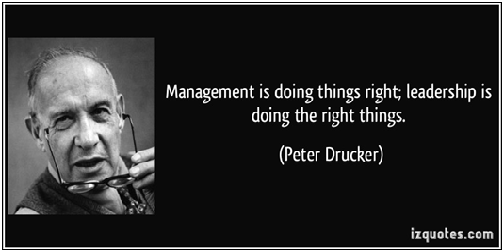

Talking of  Managementvs leadership both are complementary and distinctive system of actions. Each has its particular functions. Both of them are significant for the success in a progressively complex and in a volatile environment of the business. Strong leadership with a weak management is not even better than the reverse. The real challenge is to combine strong management and strong leadership and use each one of them so as to balance the other.
Management works by a manager who controls a set or a group of entities so as to accomplish a particular goal. On the other hand, leadership refers to a person’s ability to motivate, influence and enable other people to contribute towards the success of the organization. Inspiration and influence separate leaders from the manager, but not control and power.

 Difference Between Leader And Manager

The main difference between leader and manager is how they motivate people who follow or work for them, and this sets a good tone for most aspects they deal.
The manager mainly;
  •   Solves and controls problems. They keep an eye on the outcomes, detect any variation from the formal plan, and organize projects so as to correct such variations.
  •   Budgets and plans. The tasks of a manager involve setting up of timetables while allocating the needed resources so that there is the execution of the function.
  • Staffs and organizes the organization. He or she sets up a concrete structure to achieve a defined plan, delegate authority for the implementation of a program, creates systems that monitor the performances. They also provide procedures and policies so as to guide the staff.
  • Manager has an authoritative position vested in them by the firm. The style of management is authoritative and transactional, where a manager tells the subordinate what to do.
Thus, the crux of the management is order and predictability so as to achieve short term goals and results for stakeholders, clients and the staff.
In contrast, a leader mainly:
·   Aligns people in such a way that they have a shared mission and vision of the organization. The leader mainly communicates direction so that everyone cooperates, accept, understand and actively act upon the goals of the organization.
·        He or she establishes directions. A leader develops basic strategies and visions for the organization.
·    Inspires and motivates people. A good leader helps each and every individual to overcome barriers to changes, by satisfying the basic human need.
·    He or she leads people based on a charismatic and transformational style. Leaders mainly appeal to people so that people can feel a fulfillment of the heart's desires. Leaders with a charisma that is string find it easier to attract people to some causes. They mainly persuade people by promising a transformational benefit, such that their followers will not only receive the most extrinsic reward but also become better individuals in the society.

The essence of leadership in a firm is changing so as to achieve long-term results such as new markets, and breakthrough products. Management often deals with the status quo of the existing states of affairs while leadership deals with the future position of relations that involves a breakthrough in an organization. Systems and structures are the primary tools manager use while leaders tend to use vision and culture. Overall, the difference between leadership and management is very fine.
Sources
https://www.simplilearn.com/leadership-vs-management-difference-article

Wednesday, 21 June 2017

The Important Issues In Project Management


Project Management Handles Several Issues

Any Project management is expected to go through some phase whereby huge issues arise and needs problem solving and management. There are so many debates and matters based on the stakeholders, clients, ethics, the workforce, and processes in the most organization that threaten the success of the enterprise.

Concurrent Issues Of Project Management


However, the following are the most concurrent issues most organization faces:
Leadership

A successful project supports the best methods, practices while adhering to appropriate standards by moving an idea from a conceptual stage through execution into implementation and delivery. Leadership is more than just managing the organization. It goes all the way to influencing relationships that will help in the success of the enterprise. Leadership is majorly concerned with doing the rights things while management is merely concerned with the doing of things right. Leaders look at the holistic part of the organization, and there is an entirely different focus on communication, teamwork, and motivation. While a manager can do all these things, the leader approaches these issues from a different perspective by setting tasks into some context.
Leadership sties the strands together. A lot of people do not need to be micro-managed, this is because control and command structure don’t workin all circumstances. Those project managers who cannot fully comprehend and cooperate in a leadership capacity when the need arises, go through a tough time brazing the economy.

Risk/Hazards

There is a particular and definite focus on the management of risk in response to a challenging economy. In many areas, companies are averse to risk because the investments need guarantee so as to give the finest results. Companies should be prepared to handle risks. The improvements in technologies and costs that are lower provide a baseline for management of risk simulation and profiling of risk tools.
Value
In most companies, there is a shift from benefits to that of value. Benefits are solid objects delivered due to the success of a project through increased sale and faster handling of call times. The value, on the other hand, is about the proposition of customers by making people feel more appreciated and feeling good about brands of the organization. Value relates more of difficult emotions since it relates to how most people feel about the end products. Value concerns the relationships of stakeholders far much more than the benefits can achieve. Value involves appreciation of each person within and outside the organization, that is, the employees, the stakeholders and the clients.
Talent Management
Successful projects should make sure that each and every team member has training and support they need. It should be able to address the gaps in talents by being more inclusive in defining people by helping them do their jobs to the best of their abilities.
Talent Management is necessary so that each and every employee can be able to maximize the best of their skill when carrying out tasks. Talent Management helps foster healthy relationships by actually inspiring and motivating the employees as opposed to when a person works under pressure.
Project Management works best If they follow all the concurrent issues carefully and precisely.

Thursday, 15 June 2017

Finding The Right Project Management System

Proper Project Management System Is Effective


When the experienced and quality project managers retire, various firms replace them with inexperienced staff that is reliant on the management of data. Thus, a lot of companies get downsized, compromising the administration of the projects and overall work and quality of construction. Without an appropriate and significant project management system in place, the company may fail at last.

Skill And Technology For Planned Project Management
 The Skills That Matter

Effective leadership in conjunction with competent leadership and strategic thinking and management are the most significant competencies in the management role of construction companies respectively. From a survey conducted by the US Construction Industry Talent Development Reports, control of projects and strategic planning were the toughest capabilities and aptitudes for most managers to learn. It is whereby new technology and management of data come into action.
 A company should not over rely on a vastly experienced manager of the project, lest they retire or leave. There should be the practical training of other staff that could run for a manager as well. Most managers used the management of the information system so as to bridge the existing gaps.

Using Technology To Manage

Most companies fail when they don’t have the new technology to handle the project. A good system should handle the workflows appropriately. It ought to improve the accountability of the sites such as the logging of the safety certificates, the working hours of the staff as well as the mix of the crew. The RFID badge is one of the best examples of how technology helps to carry out some management of donkey and heavy work. By ensuring that each employee has one, the manager will have easy access to the real time data. In the long run, this will massively help in the daily planning and run of activities. Thus these gadgets prove to be more indispensable especially in the process of quality the newly employed staff.

Finding The ‘Right’ System

A good system constitutes of:

Long term value: This is whereby multiple issues are identified across the business and evaluating the best system so as to alleviate and solve all the arising problems.


Empower staff: This where by the staff are adequately trained and taught the fundamentals of the company. A formal training by all the employees’ is necessary, so as to ensure the smooth running of the business.


Vendor expertise: When buying software, it should have a good system that should come along with a substantial deal of support.

What System Needs To Have


Adjustability: A good system should work across various variable of the business such as the number of staff and the size of the site.


 Ease of use: The best system should work well for all the employees of the company.


 An open platform: There is a need for a system to merge with another system that is compatible with all the links in the chains which adequately fits the day to day running of the business. Having transparency over productivity and working hours is the most essential and powerful tool for a successful project management of the businesses


Tuesday, 13 June 2017

Fundamental Skills For Every Project Manager

A good project manager makes a significant difference between a project that comes right in time, on a budget, or it rendered as a failure.  A dedicated project manager can bring success to the company in a very short period of time. The project manager should possess the following skills so that he or she can efficiently manage a project successfully while keeping the project on track:


COMMUNICATION
Having the ability to communicate well is one of the core competencies for the management of a project. Excellent communication is the heart of most relationships. Thus the effectiveness of a project manager to communicate well has a huge impact on the stakeholders, clients, and the project team members. Excellent communication gets the manager continually aligned with his or her stakeholders and customers, thus there is the creation of a solid relationship with clients, and eventually the success of the project.
The key to adequate communication skills involves the ability to listen, to be clear and to ensure your party understands you. When information flows in with suitable and right messaging, to the right person, at the right time, through the right channels, almost all problems and hurdles are easily overcome.

NEGOTIATION  SKILLS
Project management is somehow like politics; it brings together disparate groups of people, mostly with the interest of competing. Thus, it is the job for the project manager to get the different interests on the same page, so that he or she can accomplish the project goals. Negotiation skills require investment in time so as to understand both relationships and the interests of stakeholders. The successful project manager knows how to negotiate and find compromises and how to hold the organization without ruining and damaging the relationships in the workplace. They often find a middle ground so that they can create a win-win situation.


RISK  MANAGEMENT
Project managers are the best targets whenever a project goes wrong. The manager should be able to have the ability to master and identify risks before they become significant issues, and come up with the best and efficient mitigation plans and nullify the problem. Identification of risk needs a follow-up by the risk plan. It involves assigning costs, probabilities, owners, and use of mitigation strategies suitable for the occurring risk. These action plans need incorporation into the original plan and need tracking as well.

LEADERSHIP
Great leadership is an essential skill for being a good project manager. Good leadership roles mean a person can be able to manage and lead teams, motivating teams, serving them, inspiring others, coaching and setting the visions for the team. The project manager should lead from both operational and strategic perspectives.
Every project needs a good leader who can support the team, client, and the entire process. The key to leadership skill is to make sure that you are leading other than just managing them. It means proving a road map and a vision for success, empowering and serving your entire team.

TEAM  MANAGEMENT
Besides leading their team from a strategic point of view, the project manager also needs to manage them from an operation perspective. An active manager excels at coordinating and administering groups of people by delegating tasks, setting goals, promoting teamwork, and evaluating performance index of the team members.

PLANNING  SKILLS
Proper scheduling is a vital project management skill in any organization. The ability to organize involves taking in the right order, so as to hit the right outcomes at the right time. Proper planning means that the project manager has programmed him or herself such that they are ten steps ahead and have a plan for the next thing.
It even means that the project manager can manage everything from Meta to micro, that is, the creation of great meeting, resource planning, and statements of estimates, works, and briefing.