Showing posts with label nibt-blogs. Show all posts

Tuesday, 26 December 2017

Difference Between Leadership And Management


Minor Difference Between Leadership And Management
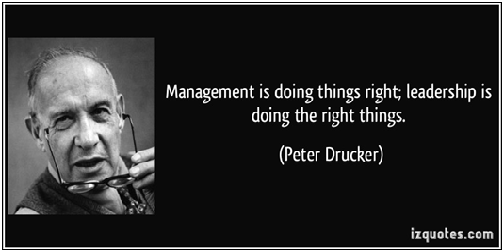

Talking of  Managementvs leadership both are complementary and distinctive system of actions. Each has its particular functions. Both of them are significant for the success in a progressively complex and in a volatile environment of the business. Strong leadership with a weak management is not even better than the reverse. The real challenge is to combine strong management and strong leadership and use each one of them so as to balance the other.
Management works by a manager who controls a set or a group of entities so as to accomplish a particular goal. On the other hand, leadership refers to a person’s ability to motivate, influence and enable other people to contribute towards the success of the organization. Inspiration and influence separate leaders from the manager, but not control and power.

 Difference Between Leader And Manager

The main difference between leader and manager is how they motivate people who follow or work for them, and this sets a good tone for most aspects they deal.
The manager mainly;
  •   Solves and controls problems. They keep an eye on the outcomes, detect any variation from the formal plan, and organize projects so as to correct such variations.
  •   Budgets and plans. The tasks of a manager involve setting up of timetables while allocating the needed resources so that there is the execution of the function.
  • Staffs and organizes the organization. He or she sets up a concrete structure to achieve a defined plan, delegate authority for the implementation of a program, creates systems that monitor the performances. They also provide procedures and policies so as to guide the staff.
  • Manager has an authoritative position vested in them by the firm. The style of management is authoritative and transactional, where a manager tells the subordinate what to do.
Thus, the crux of the management is order and predictability so as to achieve short term goals and results for stakeholders, clients and the staff.
In contrast, a leader mainly:
·   Aligns people in such a way that they have a shared mission and vision of the organization. The leader mainly communicates direction so that everyone cooperates, accept, understand and actively act upon the goals of the organization.
·        He or she establishes directions. A leader develops basic strategies and visions for the organization.
·    Inspires and motivates people. A good leader helps each and every individual to overcome barriers to changes, by satisfying the basic human need.
·    He or she leads people based on a charismatic and transformational style. Leaders mainly appeal to people so that people can feel a fulfillment of the heart's desires. Leaders with a charisma that is string find it easier to attract people to some causes. They mainly persuade people by promising a transformational benefit, such that their followers will not only receive the most extrinsic reward but also become better individuals in the society.

The essence of leadership in a firm is changing so as to achieve long-term results such as new markets, and breakthrough products. Management often deals with the status quo of the existing states of affairs while leadership deals with the future position of relations that involves a breakthrough in an organization. Systems and structures are the primary tools manager use while leaders tend to use vision and culture. Overall, the difference between leadership and management is very fine.
Sources
https://www.simplilearn.com/leadership-vs-management-difference-article

Sunday, 2 July 2017

New nanotech to cool down buildings


New Construction Trend


 Many of us live in places where air conditioning is a must, but it is also expensive and adds to energy bills. Now, scientists have found a way to cool down buildings using a particular material that can store and release energy. Scientists say this can significantly impact energy industry in future.
The new material, which is less than 2 microns thick, is made of several layers, with hafnium oxide and silicon dioxide laid on top of every layer. The material has unique properties and can combine solar reflection and radiation. In other words, the material can cool down the area in two ways. It can either reflect sunlight or radiate heat from inside of a structure. Then the heat is sent to space.

3D Printing For Smart Construction

The scientists say the material can be made in facilities that already exist and it does not require complex technologies to produce. What is especially great about this technology is it's the reverse of solar energy. Unlike solar energy, this material using coldness of an area, and it is renewable.
This new approach allows scientists to tune the infrared thermal radiation and solar reflection adequately. Researchers also compare it with a window into space. This should reduce energy consumption, carbon dioxide emission, and dependency on heating systems.

Future potential

This new material is another example of the complacency of the modern energy industry. Scientists are searching for more effective ways to do things that require a lot of energy generated from fuels.
The combination of energy storage, renewable energy, and newest technologies and materials like this will continue to influence the energy industry and lead to some players in the industry changing the way they do business, maybe even within a couple of years.

Sources:
https://www.sciencedaily.com/releases/2016/07/160727124912.htm


Thursday, 29 June 2017

Increased demand for Single family residential building in construction


Single family house the new look out of residential builders.


The residential building industry has had massive growth in the last five years, and that the trend is likely to pick up. The multifamily sector has also had a good growth streak, but analysts state that the streak is likely to decrease as most individuals begin to prefer living independently and have their homes instead of sharing. Eventually, this will, in turn, enable the single family residential building to build up in numbers. Although still, both sectors will have some growth, the single-family sector will have a greater increase compared to the multi-family residential building industry, in other terms the multi-family upward slope is slightly lower than that for the single-family sector.


Single-family house still has some bridges to cross before hitting the expected growth rate. Construction companies tend to have the perception that this area is more expensive compared to multi-family house.  It is more efficient to concentrate on multi-family housing than single family housing, but this is not always the case. Hence, this has led the sector’s growth percentage to spiral above the average level, but clients have begun to see the benefits of single housing hence their concentration on the industry.

The booming single family sector of residential building picks up steam.


The change in progress percentage in the two areas is a result of the growing number of consumers who are considering their privacy and that of their families. Also, the comfort that comes with single family house has played a defining role in the difference in growth. With all the positive statistics, the single-family sector still have some miles to cover before catching up to the growth levels of the multi–family building industry. Whether the progress in both areas is macro or micro, it is still advancement with a positive impact on the construction sector in general. Need privacy and extra space go for single family residential building.

Wednesday, 21 June 2017

The Important Issues In Project Management


Project Management Handles Several Issues

Any Project management is expected to go through some phase whereby huge issues arise and needs problem solving and management. There are so many debates and matters based on the stakeholders, clients, ethics, the workforce, and processes in the most organization that threaten the success of the enterprise.

Concurrent Issues Of Project Management


However, the following are the most concurrent issues most organization faces:
Leadership

A successful project supports the best methods, practices while adhering to appropriate standards by moving an idea from a conceptual stage through execution into implementation and delivery. Leadership is more than just managing the organization. It goes all the way to influencing relationships that will help in the success of the enterprise. Leadership is majorly concerned with doing the rights things while management is merely concerned with the doing of things right. Leaders look at the holistic part of the organization, and there is an entirely different focus on communication, teamwork, and motivation. While a manager can do all these things, the leader approaches these issues from a different perspective by setting tasks into some context.
Leadership sties the strands together. A lot of people do not need to be micro-managed, this is because control and command structure don’t workin all circumstances. Those project managers who cannot fully comprehend and cooperate in a leadership capacity when the need arises, go through a tough time brazing the economy.

Risk/Hazards

There is a particular and definite focus on the management of risk in response to a challenging economy. In many areas, companies are averse to risk because the investments need guarantee so as to give the finest results. Companies should be prepared to handle risks. The improvements in technologies and costs that are lower provide a baseline for management of risk simulation and profiling of risk tools.
Value
In most companies, there is a shift from benefits to that of value. Benefits are solid objects delivered due to the success of a project through increased sale and faster handling of call times. The value, on the other hand, is about the proposition of customers by making people feel more appreciated and feeling good about brands of the organization. Value relates more of difficult emotions since it relates to how most people feel about the end products. Value concerns the relationships of stakeholders far much more than the benefits can achieve. Value involves appreciation of each person within and outside the organization, that is, the employees, the stakeholders and the clients.
Talent Management
Successful projects should make sure that each and every team member has training and support they need. It should be able to address the gaps in talents by being more inclusive in defining people by helping them do their jobs to the best of their abilities.
Talent Management is necessary so that each and every employee can be able to maximize the best of their skill when carrying out tasks. Talent Management helps foster healthy relationships by actually inspiring and motivating the employees as opposed to when a person works under pressure.
Project Management works best If they follow all the concurrent issues carefully and precisely.